
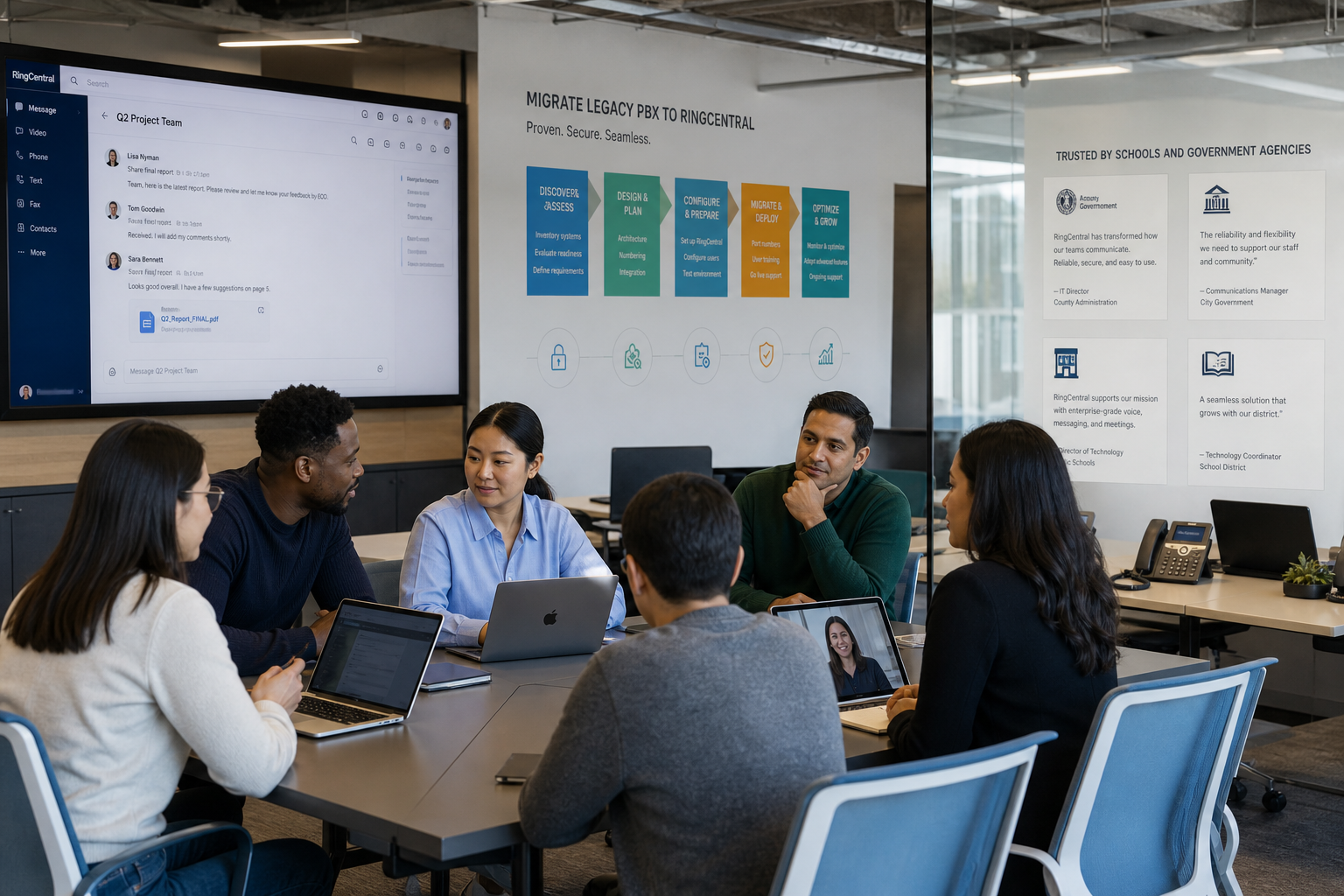
 Replace an aging phone system without losing the workflows your organization depends on
Moving from a legacy PBX to RingCentral involves much more than ordering licenses and transferring telephone numbers. Years of call routing, department workflows, analog devices, paging, emergency calling, contact-center functions and carrier services must be discovered and deliberately rebuilt.
High Country Workplace Technologies helps businesses, government agencies, school districts, healthcare organizations, hotels and multi-location enterprises migrate from Mitel, ShoreTel, Avaya and other legacy phone systems to RingCentral. HCWT is a RingCentral RingEX and RingCX Certified Delivery Partner with extensive experience supporting the legacy platforms our customers are replacing.
Contact us to Request a RingCentral Migration Assessment
A RingCentral migration built around your existing operation
A successful migration does not begin by copying every setting from the old PBX. It begins by understanding what each telephone number, extension, call flow, queue and connected device does for the organization.
HCWT documents the existing environment, identifies functions that must be preserved, finds programming that can be simplified and designs the RingCentral solution before the production number port is submitted. This approach allows the new environment to be configured and tested while the existing PBX remains in service.
The resulting design may combine RingCentral RingEX for unified communications, RingCX for contact-center operations, compatible desk phones, desktop and mobile applications, Microsoft Teams integration, online fax, analog services, overhead paging and other specialized components.
For the complete vendor-neutral methodology, see How to Migrate a Legacy PBX to a Cloud Phone System.
Legacy platforms HCWT can migrate to RingCentral
Mitel MiVoice Business
HCWT can assess MiVoice Business users, extensions, embedded and external voicemail, MiCollab, hunt groups, ring groups, contact-center functions, SIP or PRI services, analog devices, paging and multisite programming. The RingCentral design is then built around the business requirements those components serve.
Mitel MiVoice Connect and ShoreTel
MiVoice Connect and ShoreTel environments may include headquarters and distributed voice switches, Connect Director programming, workgroups, route points, auto attendants, voicemail, SIP trunks, analog extensions, paging interfaces and ShoreTel or Mitel IP phones. HCWT understands these systems and can translate their functions into an appropriate RingEX or RingCX design.
Please read about some of our recent Mitel to RingCentral migrations
City of Cheyenne Mitel Connect to RingCentral
El Paso School District 49 Mitel Connect to RingCentral
Avaya IP Office and Avaya Aura
Avaya migrations require careful review of hunt groups, short codes, auto attendants, voicemail, applications, trunks, contact-center operations, analog stations and endpoint requirements. HCWT can document the current Avaya environment and rebuild the required workflows in RingCentral.
Please read about some of our recent Avaya to RingCentral success stories.
NEC, Toshiba, Nortel, Cisco and other PBX systems
Even when complete system documentation is unavailable, HCWT can inventory users, numbers, devices, call paths and carrier services. The migration can then be designed from verified operational requirements rather than relying on outdated records.
What HCWT evaluates before recommending a RingCentral design
The discovery process may include:
- Users, extensions, locations, departments and administrators
- Main numbers, direct numbers, toll-free numbers and fax numbers
- Auto attendants, schedules, holiday routes and emergency closures
- Hunt groups, pickup groups, call queues and overflow destinations
- Receptionist, executive-assistant and shared-line workflows
- Contact-center agents, supervisors, recordings, reporting and callback requirements
- Desk phones, conference phones, softphones and mobile users
- SIP trunks, PRI circuits, analog lines and carrier contracts
- Fax, paging, elevator phones, alarm panels, door phones and other specialty devices
- Emergency calling locations and notification requirements
- CRM, Microsoft 365, Microsoft Teams and business-application integrations
- Network, firewall, switching, cabling, internet redundancy and backup power
This inventory becomes the basis for licensing, system design, implementation scope, porting and cutover planning.
RingEX, RingCX or both?
RingEX supports business calling, voicemail, messaging, video, mobility, SMS, fax and common call-routing requirements. RingCX is intended for organizations that need more advanced customer-interaction capabilities such as skills-based routing, digital channels, supervisor tools, quality management, advanced analytics or more sophisticated agent workflows.
Not every employee requires the same license. HCWT can separate office users, mobile users, common-area phones, limited-use devices, queue members, contact-center agents and supervisors so the design reflects actual job functions.
Do not submit the production port first
Telephone-number porting should follow discovery, design, configuration and testing—not precede them. HCWT’s preferred sequence is to build the RingCentral environment, test users and call flows with temporary numbers, validate devices and integrations, prepare employees and then complete the production port according to an approved cutover plan.
Existing carrier service should remain active until all required numbers have transferred successfully and the new environment has been validated. Complex organizations may benefit from a pilot or phased migration so that lessons from the first users or locations can be applied to the remainder of the project.
What happens to phones, fax, paging and analog devices?
Some existing desk phones may be compatible with RingCentral, but model, hardware revision, firmware, ownership and provisioning method must be confirmed. Reusing a phone should be based on supportability and user requirements—not merely on whether the device can register.
Fax machines, paging systems, elevator phones, alarm panels, door-entry devices, modems and other analog equipment must be assessed individually. Depending on the application, the right answer may be an analog adapter, cloud fax, purpose-built analog service, equipment replacement or retaining a local line. Life-safety devices require coordination with the equipment vendor, monitoring provider, authority having jurisdiction and applicable codes.
Why organizations choose HCWT
HCWT brings experience on both sides of the project. We understand RingCentral deployment, but we also understand the Mitel, ShoreTel and Avaya systems being replaced. That helps us identify legacy programming and connected equipment that can be missed when a migration is treated as a simple license sale.
HCWT migration services can include:
- Legacy PBX discovery and configuration review
- RingEX and RingCX solution design
- Licensing and endpoint recommendations
- Network-readiness assessment
- Call-flow, queue and auto-attendant configuration
- Device staging and user provisioning
- Telephone-number porting and carrier coordination
- Analog, paging and specialty-device planning
- Microsoft Teams, CRM and application integration
- Pilot testing and acceptance testing
- User, agent, supervisor and administrator training
- Cutover support and post-migration optimization
HCWT supports customers throughout Colorado and across the United States.
Ready to plan your migration?
Begin with an assessment of the existing PBX, carrier services, users, call flows and connected devices. HCWT will help determine whether RingCentral fits the organization’s requirements and develop a migration plan that protects essential communications throughout the transition.
Contact HCWT to start your migration
Frequently Asked Questions About Legacy PBX-to-RingCentral Migration
Can HCWT migrate a Mitel, ShoreTel or Avaya PBX to RingCentral?
Yes. HCWT can assess Mitel MiVoice Business, MiVoice Connect, ShoreTel, Avaya IP Office, Avaya Aura and other legacy PBX environments and design the appropriate RingCentral replacement. The work can include discovery, licensing, call-flow configuration, number porting, devices, analog services, testing, training and cutover support.
How long does a legacy PBX-to-RingCentral migration take?
A straightforward single-location migration may take several weeks, while a multisite organization, government agency, school district or contact center may require several months. Timing depends on the number of users and locations, network readiness, device availability, number portability, analog equipment, integrations, testing and procurement requirements.
Can we keep our existing telephone numbers?
In most cases, existing telephone numbers can be ported to RingCentral. Before the port request is submitted, the legal business name, service address, billing telephone number, account number, authorized signer and complete number inventory should be verified against current carrier records.
Should the numbers be ported before RingCentral is built?
No. The RingCentral environment should normally be designed, configured and tested with temporary numbers before the production port. Porting too early can force an organization into service before call flows, phones, applications, emergency locations and specialty devices are ready.
Can we reuse our existing desk phones?
Some phones may be reusable, but compatibility depends on the model, hardware revision, firmware, ownership and RingCentral provisioning requirements. HCWT evaluates whether reuse is supportable and cost-effective before recommending it.
What happens to fax machines, paging systems and analog devices?
Each device must be evaluated individually. Some applications can use a supported analog adapter or cloud service, while others may require purpose-built analog connectivity, new equipment or a retained local line. Life-safety devices require additional coordination and compliance review.
Can the old PBX and RingCentral operate at the same time?
Yes. A pilot or phased migration can allow both systems to operate during the transition. The design may require temporary forwarding or other routing so inbound calls, internal dialing, caller ID, voicemail and departmental workflows continue to function correctly.
Migrating from a legacy PBX to a cloud phone system can reduce dependence on aging hardware, simplify administration, support employees in multiple locations, and provide modern calling, messaging, video, mobility, analytics, and contact-center capabilities. However, the best migration is not simply a matter of replacing desk phones and moving telephone numbers to a new carrier.
A successful project begins with a detailed assessment of the existing environment, followed by thoughtful design, testing, user preparation, and a carefully managed cutover. Organizations that skip these steps can discover too late that an overlooked fax machine, elevator phone, emergency line, call queue, paging system, or network limitation affects operations.